How to Choose Non Toxic Toddler Shoes for Everyday Wear
Non toxic toddler shoes are made from materials you can name, held together with water-based or low-solvent glue, and sized with room to grow. Check the materials list, look for third-party testing such as OEKO-TEX, and measure your child’s foot at home before you buy. This guide covers trainers, sandals and casual shoes.
What does non toxic actually mean on a toddler shoe?
“Non toxic” is a marketing phrase, not a defined standard for shoes, so it only means something when the brand backs it with named materials and testing. Many markets already limit substances like lead and certain phthalates in children’s products. A shoe sold legally meets that baseline, and a good non toxic claim goes further.
When you see the phrase, turn it into three questions:
- What is each part made of? Upper, lining, insole, sole and hardware should each be listed.
- What holds it together, and what finish is on it? Glues, dyes, waterproofing and stain-resistant coatings are where most of the questionable chemistry sits.
- Who tested it? A named certification or a test report beats an adjective.
If a product page cannot answer any of these, the claim is decoration. That is useful to know before you pay for it.
Which materials are worth looking for, and which should you question?
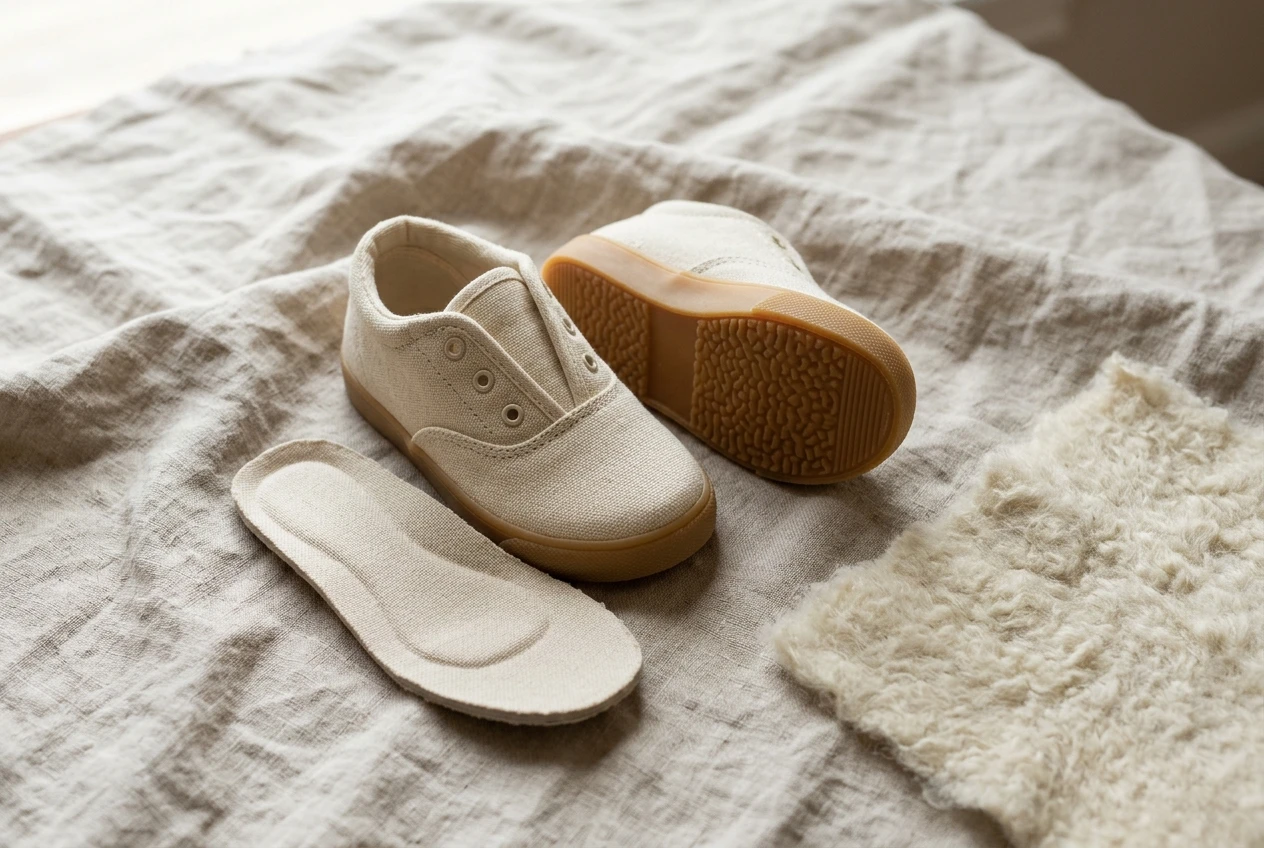
Look for materials that are simple, named and certified, and question any that are vague or coated. The table below covers the parts of a casual toddler shoe.
|
Part |
Worth looking for |
Worth questioning |
|---|---|---|
|
Upper |
Cotton or canvas, wool, or leather with a stated tanning method |
“Synthetic upper” with no detail, heavy coatings, strong dyes that rub off |
|
Lining and insole |
Cotton, wool or leather, removable so you can inspect them |
Foam with a strong chemical smell, glued-in insoles with no material listed |
|
Sole |
Natural rubber, or a named foam such as EVA with a testing statement |
Hard PVC or vinyl soles, “rubber blend” with no explanation |
|
Water or stain resistance |
A named treatment with a stated certification |
“Water-repellent” with no further information, since some finishes use fluorinated chemicals (PFAS) |
|
Adhesive |
Water-based glue, stated by the brand |
No mention of glue at all |
|
Hardware |
Buckles, snaps and eyelets with a stated testing standard |
Shiny metal trim on a product with no test information |
PVC deserves its own note. It is stiff on its own and is usually softened with plasticizers, which is why PVC-free is a common filter for children’s footwear. Rain boots are where PVC shows up most, so they are covered in a separate guide linked at the end.
Which certifications actually help?
- OEKO-TEX Standard 100 tests textile components for harmful substances. OEKO-TEX also has a separate Leather Standard.
- GOTS applies to organic textile fibers, so it covers a canvas or cotton upper, not the glue or the sole.
- Leather Working Group audits the environmental practices of tanneries. It does not test the finished shoe for harmful substances.
Check what the certificate covers. A cotton lining can be certified while the sole and glue are not.
How do you measure your toddler’s foot at home?
Trace the foot on paper, measure from heel to the longest toe, and compare that number to the brand’s own size chart. Do it in the late afternoon, when feet are at their largest.
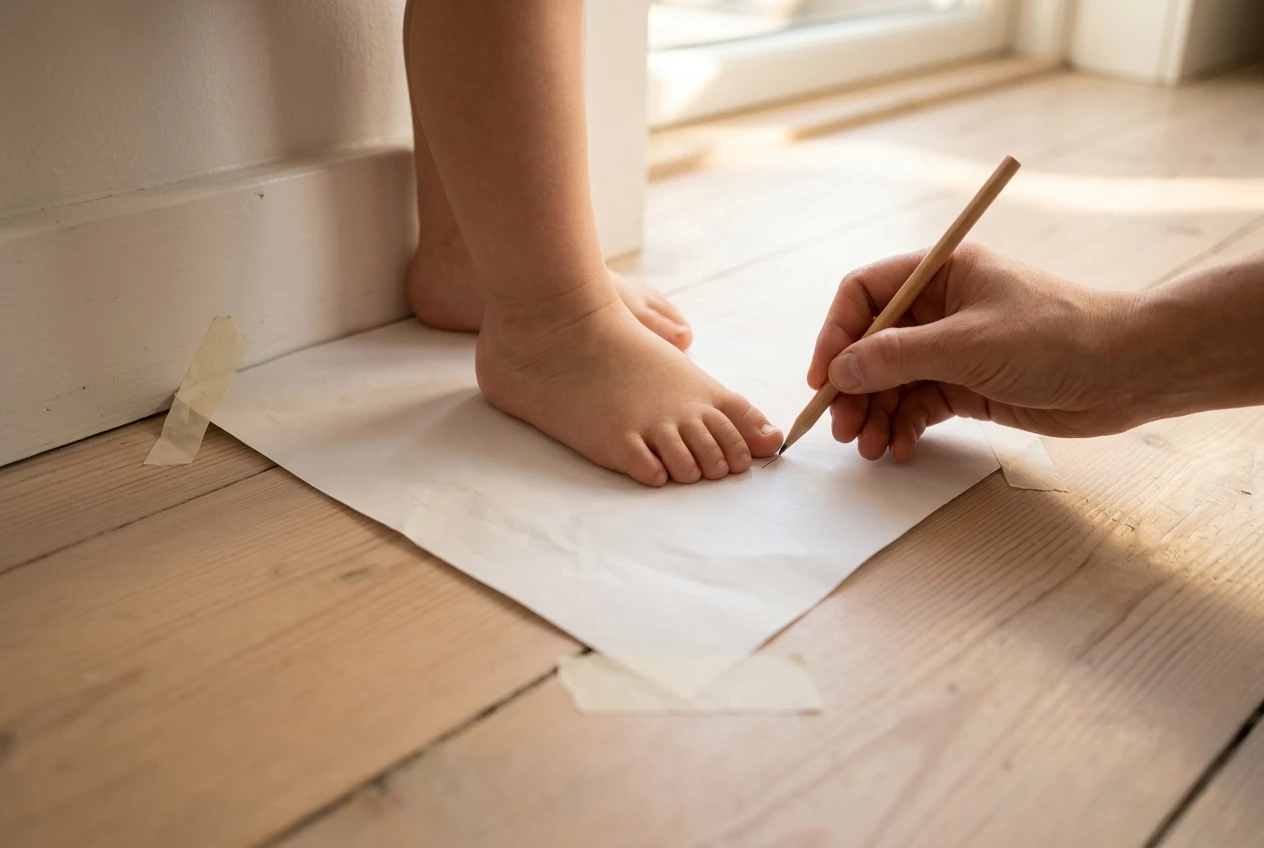
- Tape a sheet of paper to a hard floor with one edge against a wall.
- Have your toddler stand on the paper with their heel touching the wall, wearing the socks they usually wear with these shoes.
- Mark the tip of the longest toe. On some toddlers it is the second toe, not the big toe.
- Measure from the wall to the mark in centimeters or inches.
- Mark the widest part of the foot across the ball, and measure that too.
- Repeat with the other foot and use the larger measurement.
Check what the size chart says about growth room. Some brands build room into their listed foot length and some do not, so read the notes under the chart. As a rule of thumb, a toddler shoe should leave about a thumb’s width between the longest toe and the front of the shoe once your child is standing.
If your toddler will not stand still, trace the foot while they watch a short video or eat a snack. A second tracing is better than a wobbly first one. Measure again every couple of months, because a size that fit in September may be tight by the new year.
What fit signs tell you a shoe is right, too small or too big?
A right-fitting shoe has room at the toe, a snug heel and a sole that bends where the foot bends. Toddlers often cannot say that a shoe hurts, so look at the foot and the way they walk.
|
What to check |
Right |
Too small |
Too big |
|---|---|---|---|
|
Toe room |
About a thumb’s width ahead of the longest toe |
Toes touch the front, or curl |
More than a thumb’s width, toes slide forward |
|
Heel |
Stays put when your child walks |
Heel pops out because the foot is cramped |
Heel slips up and down with each step |
|
Width |
Upper sits flat across the ball of the foot, closure fastens without strain |
Bulging at the sides, closure barely reaches |
Upper wrinkles and folds over the foot |
|
Flex point |
Sole bends under the ball of the foot |
Sole seems stiff because the foot is pressing on it |
Sole bends in the middle of the arch |
|
After wearing |
Skin looks normal |
Red marks or dents on toes, sides or heel |
Blisters at the heel or tops of the toes |
|
Walking |
Natural stride |
Shuffling, refusing to wear them |
Tripping, dragging toes |
Fit also changes with socks. Always try shoes with the socks they will actually be worn with.
Which daily wear features make a toddler shoe easier to live with?
The features that matter most are the ones that make shoes easy to put on, comfortable to walk in and simple to clean. For a toddler who wears the same pair most days, these count more than the style.
- A flexible sole. Bend the shoe with your hands. It should flex easily at the ball of the foot.
- A light weight. A heavy shoe makes a toddler lift their feet higher and tire sooner.
- A wide, rounded toe box. Toes need space to spread as your child walks.
- A low, flat heel. Raised heels push the foot forward into the toes.
- A grippy tread. Look for a pattern that grips on wet pavement and smooth floors.
- Hook-and-loop or elastic closures. Toddlers can start practicing with them, and you get dressed faster. Check that the strap fastens across the widest part of the foot.
- A wide opening. A shoe that opens far lets you get the foot in without a struggle.
- A removable insole. You can wash it, dry it and check what is under it.
- A reinforced toe. Toddlers drag their feet, and a scuffed, split toe wears out first.
- Washable materials. Check the label to see whether the shoe can go in a washing machine or only be wiped clean.
For sandals, add a closed or reinforced toe and a heel strap that actually holds. A sandal that slips off needs constant fixing and gets tossed in the bin.
How do you check a shoe in the store or online before buying?
In a store, you can handle the shoe. Online, you need the product page, the size chart and the return policy to do the same job. Either way, work through the same list.
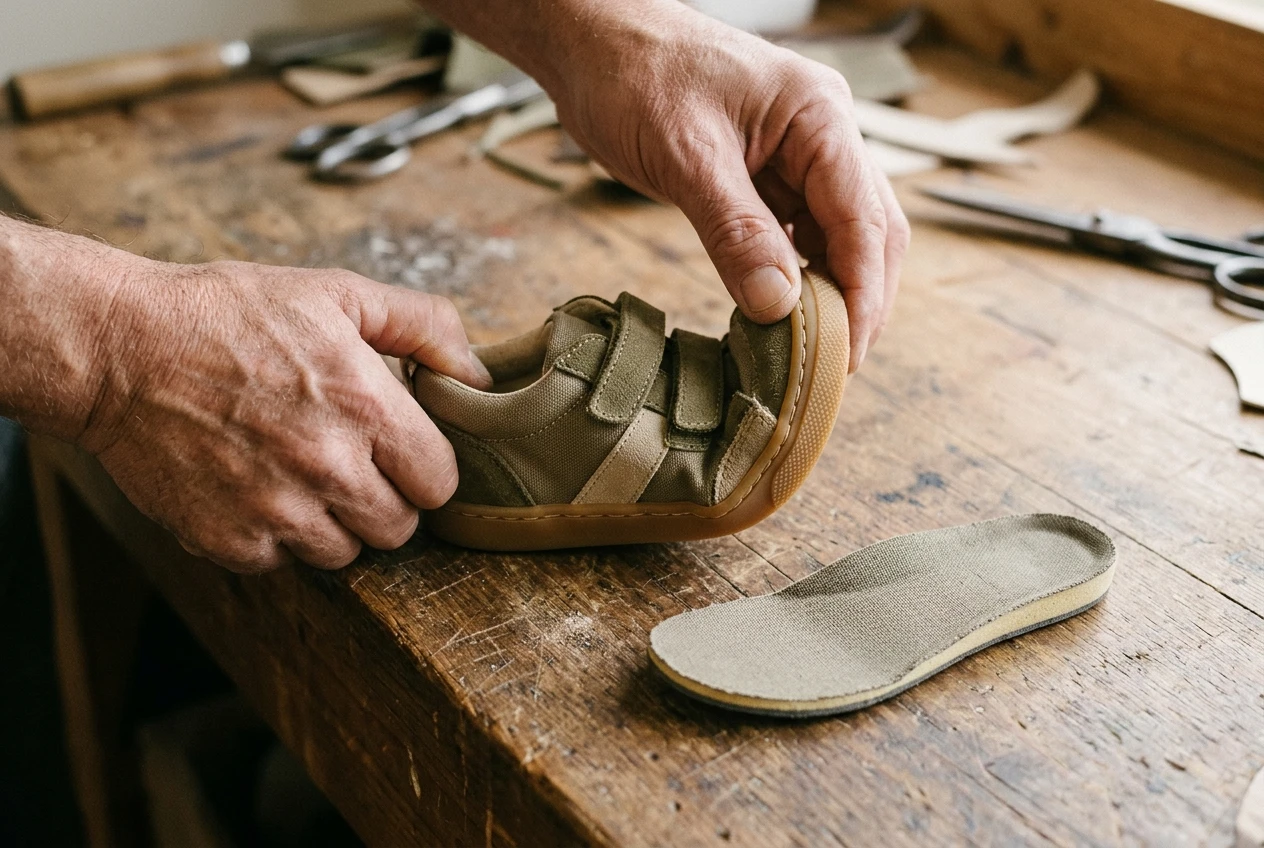
In a store:
- Bend the shoe. It should flex at the ball of the foot, not in the middle.
- Twist it gently. A very stiff shoe will barely twist.
- Smell it. A sharp chemical odor can point to solvent-based glue or coatings.
- Pull out the insole and look at the base of the shoe and the glue lines.
- Check the stitching around the toe and heel for loose threads.
- Have your toddler walk and run in them.
Online:
- Look for a materials list that names the upper, lining, insole and sole.
- Look for a statement about adhesives, dyes and water-repellent finishes.
- Look for a named certification, and check which parts of the shoe it covers.
- Compare your measurement to the brand’s size chart, not to a size you bought somewhere else.
- Read the return and exchange policy before you order, because sizing between brands varies.
- Email the seller if the page leaves out something you need. A brand that is proud of its materials will usually answer in a sentence or two.
Skip anything that relies on words like “eco,” “clean” or “pure” without naming a material or a test.
How do you care for the shoes so they last and stay clean?
Clean shoes by hand, dry them slowly and rotate pairs. This protects the glue and the materials you picked carefully.
- Check the care label first. Some canvas shoes can go in the washing machine and many leather shoes cannot.
- Knock off loose dirt, then wipe the upper with a damp cloth and a drop of mild soap.
- Take out the insoles and wash or wipe them separately.
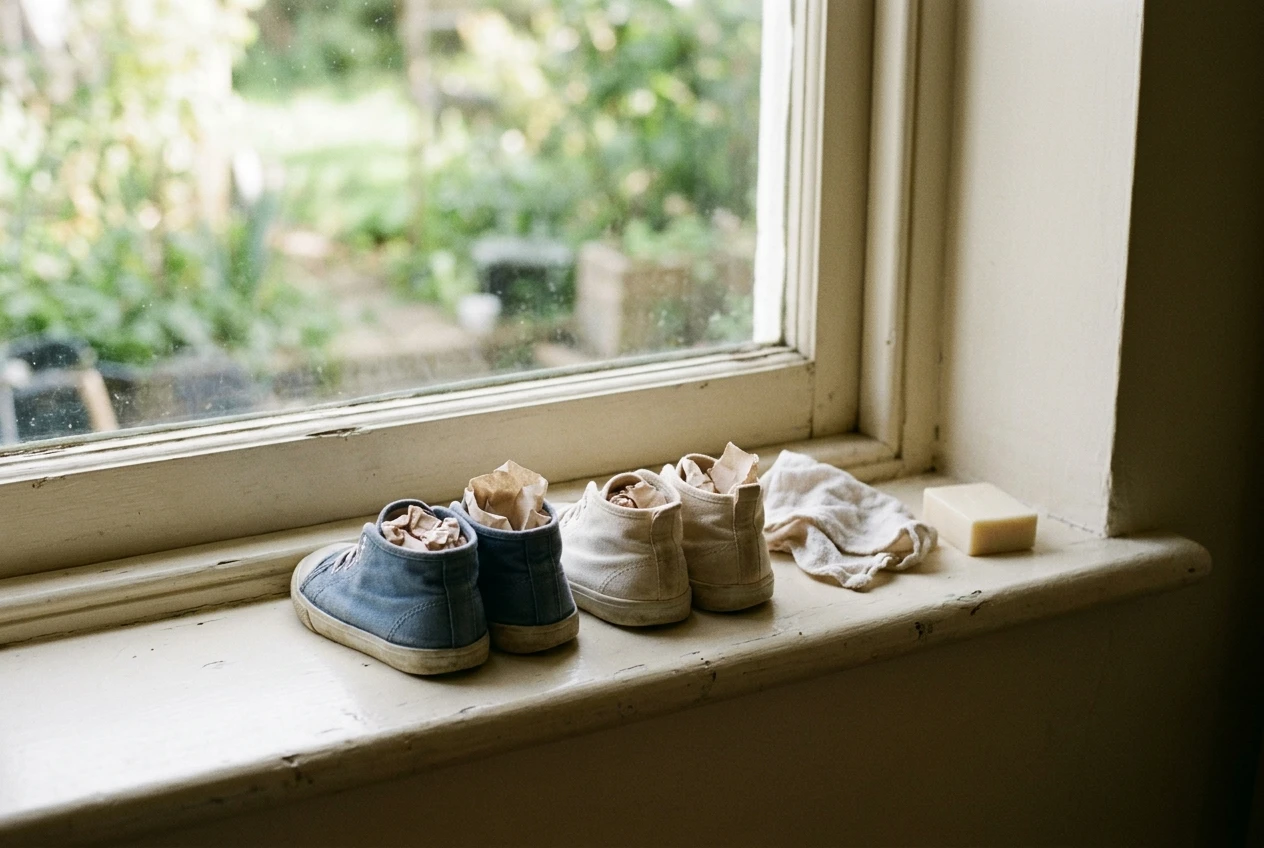
- Stuff the shoes loosely with clean paper to hold their shape while they dry.
- Dry them at room temperature, away from radiators and direct sun. Heat can weaken glue, warp soles and stiffen leather.
- Rotate between two pairs if you can, so each pair dries fully between wears.
Keep the sole’s tread clear of stones and mud, since packed tread loses its grip. Check the toe and heel every few weeks for wear, and retire a pair once the sole is worn smooth or the toe box has split. Shoes that have molded to another child’s feet are also a poor fit for a hand-me-down, so measure again before passing a pair on.
Where should you go next?
If you need boots for wet weather, the non toxic toddler rain boots guide covers PVC-free and natural rubber options for your next pair.
For cold-weather socks and boots, the winter feet guide explains how to keep your toddler’s feet warm without squeezing them into a tight shoe.